The Good News: No Absolute Limit on Possession!
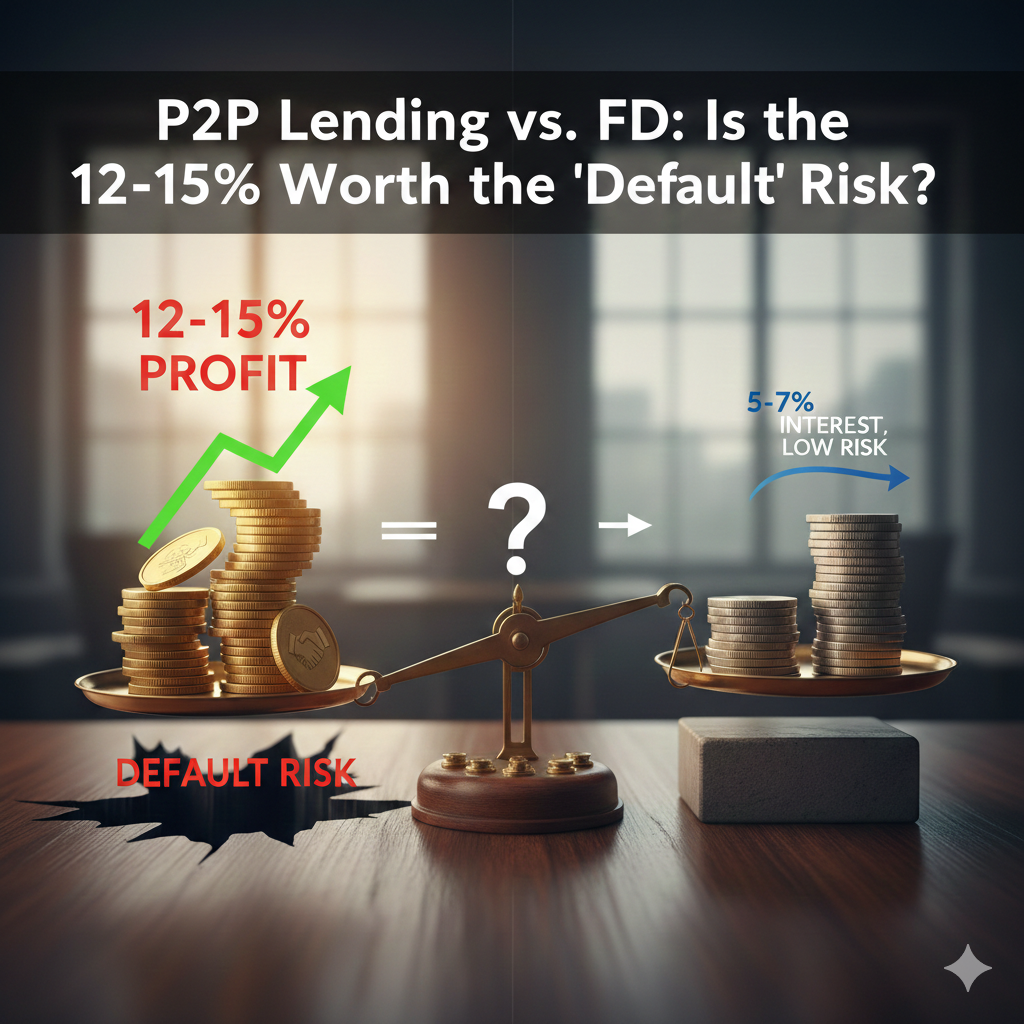
In 2026, the Indian investor is caught in a classic tug-of-war. On one side, we have the “Safe Haven” — the Fixed Deposit (FD), currently offering around 6.5% to 8.5%. On the other side, there’s the “Wild Child”—P2P Lending, promising a mouth-watering 12-15%.
At Rupee Decoded, we believe in looking at the math, not the marketing. Let’s pull back the curtain on whether P2P lending is a genius move or a gamble for your portfolio this year.
The Real-Life Tale of Two Investors: Arjun vs. Meera
To understand the “Why,” let’s look at two friends, Arjun and Meera, who both had ₹1 Lakh to invest in January 2026.
1. The FD Path (Arjun): Arjun played it safe. He opened a 1-year FD at a Small Finance
Bank offering 8%.
– Outcome: By Jan 2027, Arjun has ₹1,08,000.
– The Vibe: He slept like a baby. No stress, no tracking, just a guaranteed payout.
2. The P2P Path (Meera): Meera felt adventurous. She put her ₹1 Lakh into an RBI-
regulated P2P platform, diversifying across 100 different borrowers at an average interest rate of 15%.
– The Math: Total expected interest was ₹15,000.
– The Reality Check: Out of 100 borrowers, 4 defaulted (they didn’t pay back). Since
P2P loans are unsecured, there was no collateral to sell.
– Outcome: After accounting for the 4% default loss and the platform’s 1% service fee,
Meera ended up with roughly ₹1,10,000.
– The Vibe: She earned ₹2,000 more than Arjun, but she had to track her dashboard
every month and deal with the anxiety of seeing “Late Payments.”
P2P Lending in 2026: What has Changed?
If you think P2P is still the “Wild West,” think again. The RBI has tightened the screws. In
2026:
– Escrow is King: Platforms no longer touch your money. It moves through bank-
managed escrow accounts.
– T+1 Settlement: Your idle money can’t sit on the platform for weeks; it must be
deployed or returned within 24 hours.
– The 50L Cap: You can’t lend more than ₹50 Lakhs across all P2P platforms.
The "Risk-o-Meter": Why 15% isn't always 15%
Before you jump for that 15% return, remember the Three Pillars of P2P Risk:
1. Credit Risk: Unlike an FD, your principal is NOT insured by the DICGC (which
covers up to ₹5L in banks). If the borrower vanishes, your money might too.
2. Liquidity Risk: You can’t “break” a P2P investment like an FD. If you need cash for
an emergency tomorrow, you have to wait for the borrowers to pay their EMIs.
3. Concentration Risk: If you put ₹1 Lakh into just 5 borrowers, one default ruins your
year. Diversification is your only shield.
Comparison Table: At a Glance (2026)
The Rupee Decoded Verdict: Should You Invest?
Is the higher risk worth it? Yes, but only as a “Side Dish,” never the “Main Course.”
1. Stick to FDs if: You are saving for your child’s fees, a house down payment, or your emergency fund.
2. Try P2P Lending if: Your “basics” (Insurance, Emergency Fund, FD) are sorted, and you want to boost your overall portfolio return by 1-2%.
Pro-Tip: Treat P2P lending like a high-yield experiment. Don’t put more than 5-10% of your total capital into it.